The Forest View (TL;DR)
- CrewAI is the fastest path to a working multi-agent prototype — role-based, intuitive, and favored by ~60% of Fortune 500 teams for early automation pilots.
- LangGraph is the production standard for stateful, auditable, long-running workflows — adopted by enterprises like JPMorgan, Klarna, and LinkedIn.
- The smartest move in 2026: prototype in CrewAI, then harden production-critical paths in LangGraph — both can coexist in the same stack.
The orchestration framework wrapped around an AI model in 2026 can shift agent performance by up to 30 percentage points — even when the underlying model stays identical. Princeton’s HAL benchmark data shows Claude Opus 4 scoring 64.9% on GAIA inside one scaffold and 57.6% inside another, a gap larger than most frontier model upgrades.
That is the real stakes of this debate. Picking the wrong framework isn’t a stylistic inconvenience — it is an engineering constraint you will be refactoring around for months.
Gartner predicts 40% of enterprise applications will integrate task-specific AI agents by the end of 2026, up from less than 5% in 2025. CrewAI and LangGraph are the two frameworks at the center of that build-out. They approach the same problem from entirely different philosophies — and understanding that gap is what this article is about.
What Are These Frameworks, Really?
CrewAI: Managing an AI Team
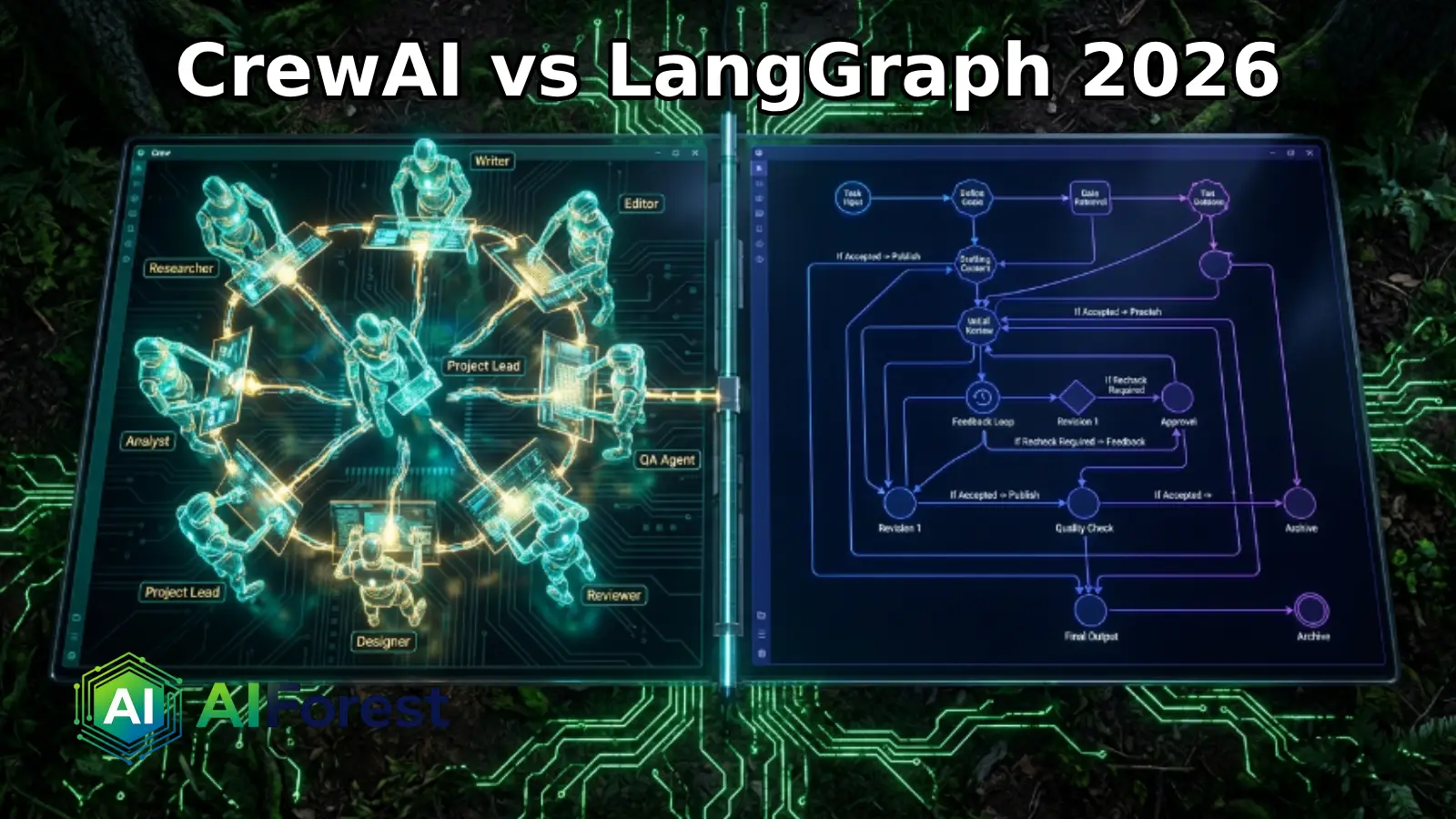
CrewAI’s core metaphor is straightforward: create agents with roles, give them tools and context, assign tasks, then coordinate their work through crews or flows. You might define a researcher agent, a writer agent, and an editor agent. The researcher gathers information, the writer turns it into a draft, and the editor improves the result.
CrewAI makes the common case trivial at the cost of making the uncommon case harder. As of early 2026, it sits at 45,900+ GitHub stars and version 1.10.1, with native support for MCP (Model Context Protocol) and A2A (Agent-to-Agent) communication, powering over 12 million daily agent executions in production.
The main benefit is speed. You can describe agents in business-friendly terms and get a working pipeline running in two to four hours.
LangGraph: Engineering an AI State Machine
LangGraph is described by LangChain as a low-level orchestration framework and runtime for building, managing, and deploying long-running, stateful agents. It is designed for persistent execution, fault tolerance, streaming, interrupts, time travel, memory, and subgraphs.
LangGraph surpassed CrewAI in GitHub stars during early 2026, driven by enterprise adoption and its graph-based architecture that maps cleanly to production requirements like audit trails and rollback points.
If CrewAI feels like managing a team, LangGraph feels like designing the system those people operate inside.
Architecture: Where They Diverge
CrewAI’s Role-Based Model
CrewAI uses role-based agent teams with intuitive task delegation. It is easier to learn and better suited for business workflows where the problem naturally maps to a team structure.
Non-technical stakeholders can actually read a CrewAI config and understand what it does. That alone makes it valuable for fast cross-functional prototyping.
LangGraph’s Graph-Based State Machine
LangGraph’s orchestration model uses a directed graph with conditional edges. Agents, tools, and checkpoints are nodes. Transitions between them are edges. You define the graph explicitly. It manages state persistence and uses reducer logic to merge concurrent updates — making it especially powerful for workflows requiring precise control over execution order, branching, and error recovery.
LangGraph’s interrupt() function and checkpointers make human approval gates explicit and auditable. You define exactly where a human needs to review, the workflow pauses, waits for input, and resumes from that precise state.
Head-to-Head Comparison Table
| Feature | CrewAI | LangGraph |
|---|---|---|
| Primary metaphor | Role-based team | Directed state graph |
| Learning curve | Low (2–4 hrs to prototype) | Moderate (explicit graph design) |
| State persistence | Sequential task outputs | Full checkpointing & reducers |
| Human-in-the-loop | Supported, less granular | Native, fully auditable |
| MCP / A2A support | ✅ Native | ❌ Community integrations only |
| Production observability | Growing ecosystem | LangSmith (mature) |
| Token efficiency | ~18% overhead vs LangGraph | Lower baseline overhead |
| GitHub stars (2026) | 45,900+ | Surpassed CrewAI in early 2026 |
| Best for | Fast prototyping, business workflows | Regulated, long-running production systems |
| Used by | Fortune 500 pilots, marketing, research | JPMorgan, Klarna, LinkedIn, Uber |
Performance: Does It Actually Matter?
CrewAI’s 2026 benchmarks show a moderate token overhead of approximately 18%. A 3-agent crew handling ticket triage and resolution required 18% more tokens than a comparable LangGraph implementation.
In multi-step research workflows involving five steps, CrewAI completes tasks in around 45 seconds versus LangGraph’s 68 seconds — the agent coordination model creates efficiency gains when multiple agents collaborate. For single-agent retrieval tasks, LangGraph’s optimized RAG chains hold the edge.
Neither framework dominates universally. The performance answer always comes back to your specific workflow shape.
Protocol Support: The Emerging Differentiator
This is a dimension most comparisons skip — and it will matter significantly over the next 18 months.
MCP (Model Context Protocol), contributed by Anthropic to the Linux Foundation’s Agentic AI Foundation, is becoming the standard for how agents connect to tools and data sources. A2A (Agent2Agent Protocol), launched by Google with 50+ technology partners, standardizes agent-to-agent communication and discovery. Today, CrewAI has added A2A support, while LangGraph has yet to adopt either standard natively.
As of 2026, CrewAI’s native support for both MCP and A2A makes it the stronger choice for agent interoperability. If your architecture involves agents from multiple frameworks communicating across boundaries, that gap is real.
When to Use Each Framework
Choose CrewAI when:
- You need a working demo or pilot within a day
- Your workflow maps naturally to a team of specialists
- Non-technical stakeholders need to read or modify the configuration
- Agent interoperability and protocol compliance matter
Choose LangGraph when:
- You are operating in a regulated industry (fintech, healthtech, legal)
- Workflows require conditional branching, loops, and durable execution
- You need full audit trails and human-approval checkpoints
- You are already using LangChain — adding LangGraph is incremental rather than a full migration
The hybrid approach: The smart play is to start with CrewAI for validation. If your workflow stays simple, stay there. The moment you need conditional logic, loops, or human approvals, move to LangGraph before your prototype becomes technical debt.
The “Human Root” — Jobs, Ethics, and the Developer in the Middle
The framework choice is not just a technical question. It is quietly reshaping what AI engineers actually do.
CrewAI’s high-level abstraction means non-engineers can participate in defining agent behavior — roles, goals, backstories. This lowers the barrier to entry, which is good for democratizing access, but it also makes it easier to deploy agents without understanding how they fail.
LangGraph, by contrast, demands that a developer explicitly model every decision point. That friction is a feature. It forces teams to think through failure states, human oversight gates, and rollback conditions before they ship. In regulated environments where auditability, deterministic control, and human approval steps matter, LangGraph’s approach fits the compliance story better.
The deeper question for 2026 is not “which tool is easier” but “who is accountable when the agent makes the wrong decision.” LangGraph builds that accountability into the architecture. CrewAI leaves more of it to the developer’s discipline.
As agentic AI expands into healthcare scheduling, financial planning, and legal research, the teams that invest in explicit state management and auditable checkpoints will face fewer regulatory problems — and fewer very expensive surprises.
The Verdict
LangGraph is best for production deployments needing state control, persistence, and human-in-the-loop oversight. CrewAI is best for multi-agent collaboration with role-based design. Both statements are true simultaneously — and that is precisely the point.
The “which is better” framing is the wrong question for 2026. The more useful question is: where in the lifecycle is your project?
CrewAI wins the prototype. LangGraph wins the production floor. The frameworks that earn long-term adoption will be the ones that let both coexist in the same stack — and right now, they largely do.
One trend worth watching: the 2026 direction across all frameworks is convergence on common abstractions, with differentiation in ecosystem depth. As MCP and A2A protocols mature, the boundaries between frameworks will dissolve further. The framework you pick today shapes your migration path tomorrow — choose accordingly.
FAQs
Yes, for most beginners. CrewAI is optimized for quickly assembling collaborative AI workers, making it especially appealing for developers who want to prototype useful automations without first designing a full graph architecture. LangGraph has a steeper learning curve but pays off once you need production-grade control.
Yes — CrewAI’s LangChain compatibility means this is not a full rewrite but a gradual transition. Many teams build fast with CrewAI, then harden the pieces that need more control in LangGraph. Planning for this hybrid from day one avoids the most painful refactoring.
LangGraph has the largest verified enterprise deployment list, including Klarna, Uber, LinkedIn, BlackRock, Cisco, Elastic, JPMorgan, and Replit. CrewAI, meanwhile, has been adopted by roughly 60% of the Fortune 500 for early-stage automation pilots. Both are in production — at different stages of the deployment lifecycle.