The Forest View (TL;DR)
- MCP is an open standard created by Anthropic in November 2024 that lets AI models connect to external tools, data sources, and services through a single, universal interface — ending the era of one-off custom integrations.
- Industry adoption happened fast. OpenAI adopted MCP in March 2025, Google DeepMind confirmed support for Gemini in April 2025, and Microsoft, AWS, Cloudflare, Bloomberg, Snowflake, and Salesforce all followed.
- MCP is now neutral infrastructure. In December 2025, Anthropic donated MCP to the Agentic AI Foundation (AAIF), a directed fund under the Linux Foundation, co-founded by Anthropic, Block, and OpenAI, with support from Google, Microsoft, AWS, Cloudflare, and Bloomberg.
The Integration Problem Nobody Talked About
By May 2026, the Python and TypeScript MCP SDKs had recorded 97 million monthly downloads — comparable growth to the React npm package, which took three years to reach similar numbers; MCP did it in 16 months. That number tells you something important: a quiet infrastructure problem in AI just got a very loud solution.
Before MCP, connecting an LLM to your company’s tools was a grind. Every AI integration was custom-built. If you wanted Claude to query a PostgreSQL database, you built an Anthropic-specific connector. If you wanted GPT-4 to do the same, you built a different one. That is the N×M problem — N AI models times M tools equals N×M custom integrations to build and maintain.
MCP eliminates that entirely. One standard. Every tool. Every major model. Here’s how.
What Exactly Is MCP?
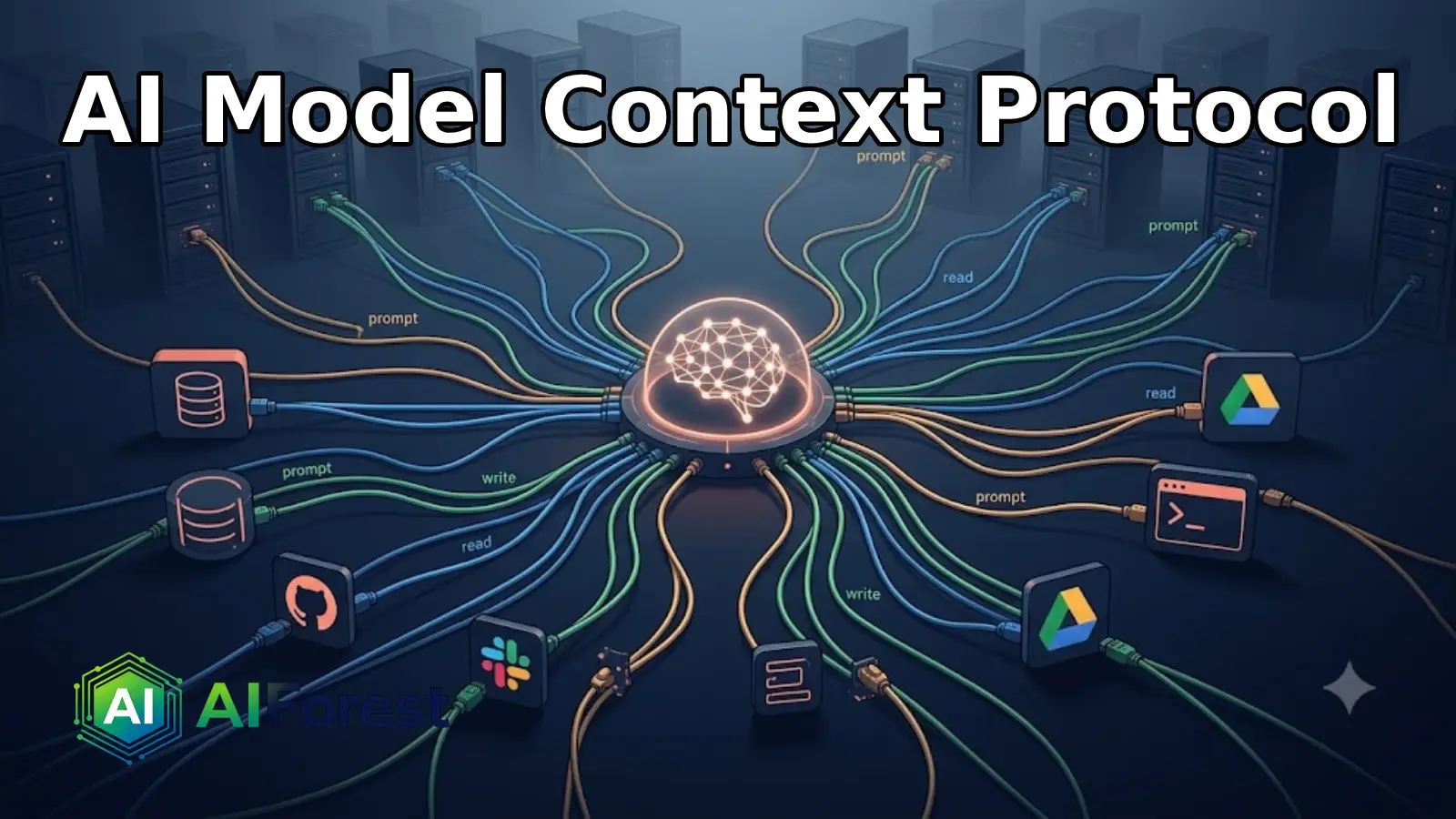
The Model Context Protocol (MCP) is an open standard and open-source framework introduced by Anthropic in November 2024 to standardize the way AI systems like large language models integrate and share data with external tools, systems, and data sources. MCP provides a universal interface for reading files, executing functions, and handling contextual prompts.
Think of it like USB-C for AI. Before USB-C, every device needed its own cable — Lightning for iPhones, micro-USB for Android, proprietary connectors for cameras. MCP does the same thing for AI integrations.
The protocol was created at Anthropic by engineers David Soria Parra and Justin Spahr-Summers. It re-uses the message-flow ideas of the Language Server Protocol (LSP) and is transported over JSON-RPC 2.0.
How MCP Actually Works
The Three-Role Architecture
MCP follows a client-server model with three roles. MCP hosts are AI applications that want to use external tools — Claude Desktop, Cursor, VS Code Copilot, your custom LLM application. MCP clients live inside the host; they connect to MCP servers, discover available capabilities, and invoke tools on the agent’s behalf. MCP servers expose capabilities — tools, resources, and prompts — to any client that connects. A server is built once and works with every MCP-compatible host.
What It Can Do
AI applications act as MCP clients, opening a two-way JSON-RPC connection to MCP servers that expose external capabilities. Through this channel, the AI can request context — files, database entries, messages — and invoke tools in a standardized format. The AI assistant can ask a data source questions, retrieve information, or execute an operation, and the server can respond or even prompt the AI for more details if needed.
The protocol is model-agnostic by design. MCP works with Claude (Anthropic), GPT and ChatGPT (OpenAI), Gemini (Google DeepMind), Copilot (Microsoft), Cursor, Replit, VS Code Copilot, and custom LLM applications using the official MCP SDKs.
MCP vs. Alternatives: A Comparison
| Feature | MCP | Traditional REST API | OpenAI Function Calling (2023) |
|---|---|---|---|
| Standard type | Open, vendor-neutral | Vendor-specific | Vendor-specific (OpenAI only) |
| AI-native design | Yes — built for LLM agents | No — requires custom wrappers | Partial |
| Cross-model support | All major models (2026) | Model-agnostic but no standard | OpenAI models only |
| Tool discovery | Built-in (server exposes capabilities) | Manual documentation required | Schema must be manually defined |
| Governance | Linux Foundation (AAIF) | N/A | OpenAI-controlled |
| Server ecosystem | 10,000+ public servers | Unlimited, but fragmented | Limited plugin store |
| Security maturity | Maturing (OAuth, gateways) | Mature | Limited |
MCP does not replace iPaaS platforms, API gateways, or data pipelines — understanding where it sits relative to existing enterprise integration infrastructure is critical for organizations evaluating adoption.
The Rise to Industry Standard
From Anthropic Experiment to Linux Foundation Asset
Over the last year, MCP accomplished a rapid rise to popularity that few other standards or technologies had achieved so quickly. The timeline is striking.
In March 2025, OpenAI adopted MCP across the Agents SDK, Responses API, and ChatGPT desktop. Sam Altman posted simply: “People love MCP and we are excited to add support across our products.” In April 2025, Google DeepMind’s Demis Hassabis confirmed MCP support in upcoming Gemini models.
GitHub and Microsoft announced they were joining MCP’s steering committee at Microsoft’s Build 2025 conference. This coalescing of significant AI leaders — Anthropic, OpenAI, Google, and Microsoft — caused MCP to evolve from a vendor-led spec into common infrastructure.
The Ecosystem Today
By April 2026, an independent census indexed 17,468 servers across all registries. The ecosystem now includes thousands of community-built servers covering development tools (GitHub, GitLab, Linear), productivity platforms (Slack, Notion, Google Drive), and specialized services in analytics, security, design, and infrastructure.
Collaboration platform Slack introduced MCP-based connectivity with Anthropic Claude in January 2026. Contact center vendors including Zoom, RingCentral, Cisco Webex, Genesys, 8×8, and Salesforce all support MCP.
MCP and Agentic AI: The Bigger Picture
MCP isn’t just a developer convenience — it’s the plumbing of the agentic AI era.
Anthropic created MCP as an open standard that allows their agents to connect to any tool seamlessly. While competitors build walled gardens, Anthropic is building a universal connector for the AI era.
In April 2025, Google announced the Agent-to-Agent (A2A) protocol, sometimes positioned as a competitor to MCP — but this misreads both protocols. A practical combined example: a customer service AI agent receives a complex inquiry. Via MCP, it queries the CRM tool to retrieve account history. Via A2A, it delegates a billing sub-task to a specialist billing agent. MCP and A2A are complementary layers of the same agentic architecture.
Honest Limitations You Should Know
MCP’s success hasn’t made it perfect. MCP faces serious criticism over security breaches, performance bottlenecks like double-hop latency, and context window bloat that degrades agent efficiency in complex multi-step workflows.
In April 2025, security researchers published analysis of MCP’s attack surface and found issues: prompt injection vulnerabilities, tool permission problems where combining tools could exfiltrate files, and lookalike tools that could silently replace trusted ones. A critical RCE vulnerability (CVE-2025-49596) was discovered in Anthropic’s MCP Inspector and patched by June 2025.
The community server ecosystem also has significant quality variance, with only 12.9% of indexed servers meeting high-trust criteria. For enterprise deployments, private registries and security gateway tools are strongly advised.
The Human Root: Jobs, Ethics, and What This Means for Workers
MCP is easy to frame as a purely technical story. It isn’t.
The solution emerging in 2026 is to treat human expertise as another callable resource in the MCP ecosystem — not as a replacement for AI, but as a reliability layer that activates when the agent needs judgment it cannot provide on its own. That framing matters enormously for how we think about workforce integration.
For knowledge workers, MCP-connected agents can now autonomously query CRMs, write reports, update databases, and trigger workflows. The roles that survive won’t be those that resist this — they’ll be those that direct it. Prompt engineers, AI integration architects, and agentic systems designers are among the fastest-growing job titles in tech right now.
With 85% of enterprises expected to implement AI agents by end of 2025, the security surface area is expanding fast. The organizations that move early on governance — not just building agents but building them safely — will have cleaner deployments and fewer incidents.
The ethical dimension is real too. An MCP-connected agent can access your calendar, email, file system, and databases simultaneously. Who audits what it does? The 2026 MCP roadmap addresses audit trails and SSO-integrated authentication — but enterprise governance frameworks are still catching up to what the protocol already enables.
The Verdict
MCP arrived at exactly the right moment. The AI industry had the models. It had the use cases. What it lacked was a shared language for connecting the two to the rest of the world’s software. This is what happens when an open standard begins to solve a real infrastructure problem at exactly the right moment.
The protocol is not finished. Security tooling is maturing, performance at scale is an open challenge, and the server ecosystem needs quality controls. But the foundation — now stewarded by the Linux Foundation and backed by every major AI company — is solid.
If you’re building with AI in 2026 and MCP isn’t in your architecture, you’re working harder than you need to. The harder question is no longer whether to use it. It’s how to use it responsibly.
FAQs
MCP is primarily a developer-facing protocol — you need to configure or build MCP servers. However, the end-user benefits are broad. Business teams using Claude, ChatGPT, or Copilot are already benefiting from MCP-powered integrations built by their IT or engineering departments, even if they never see the protocol itself.
No — and it’s important not to conflate them. RAG is a technique for improving LLM responses by retrieving relevant documents before generation. MCP is a protocol for AI agents to access tools and data sources. They are not alternatives. A common pattern is an MCP server that exposes a retrieval tool the AI agent can call; inside that tool, RAG runs against a vector database.
With care, yes. MCP has emerged as one of the key building blocks of the agentic AI stack, and its 2026 roadmap suggests the maintainers are turning their attention to what needs to be fixed before MCP can hold up in real production use. Security tooling like MCP-Scan, gateway products, and OAuth-based server authentication are available — but teams should audit their server configurations and avoid relying on untrusted public servers without vetting.