The “Forest View” (TL;DR)
- The World Economic Forum estimates AI will displace 85 million jobs globally by 2030 — but simultaneously create 97 million new ones, with the US and Europe at the center of both trends.
- White-collar and knowledge workers — lawyers, analysts, junior coders, and content writers — are now facing the same automation pressure that blue-collar workers absorbed in the 2010s.
- Across the Atlantic, the EU’s regulatory approach and the US’s market-led approach are producing two distinctly different futures for workers — and understanding that divide is now critical for employers and employees alike.
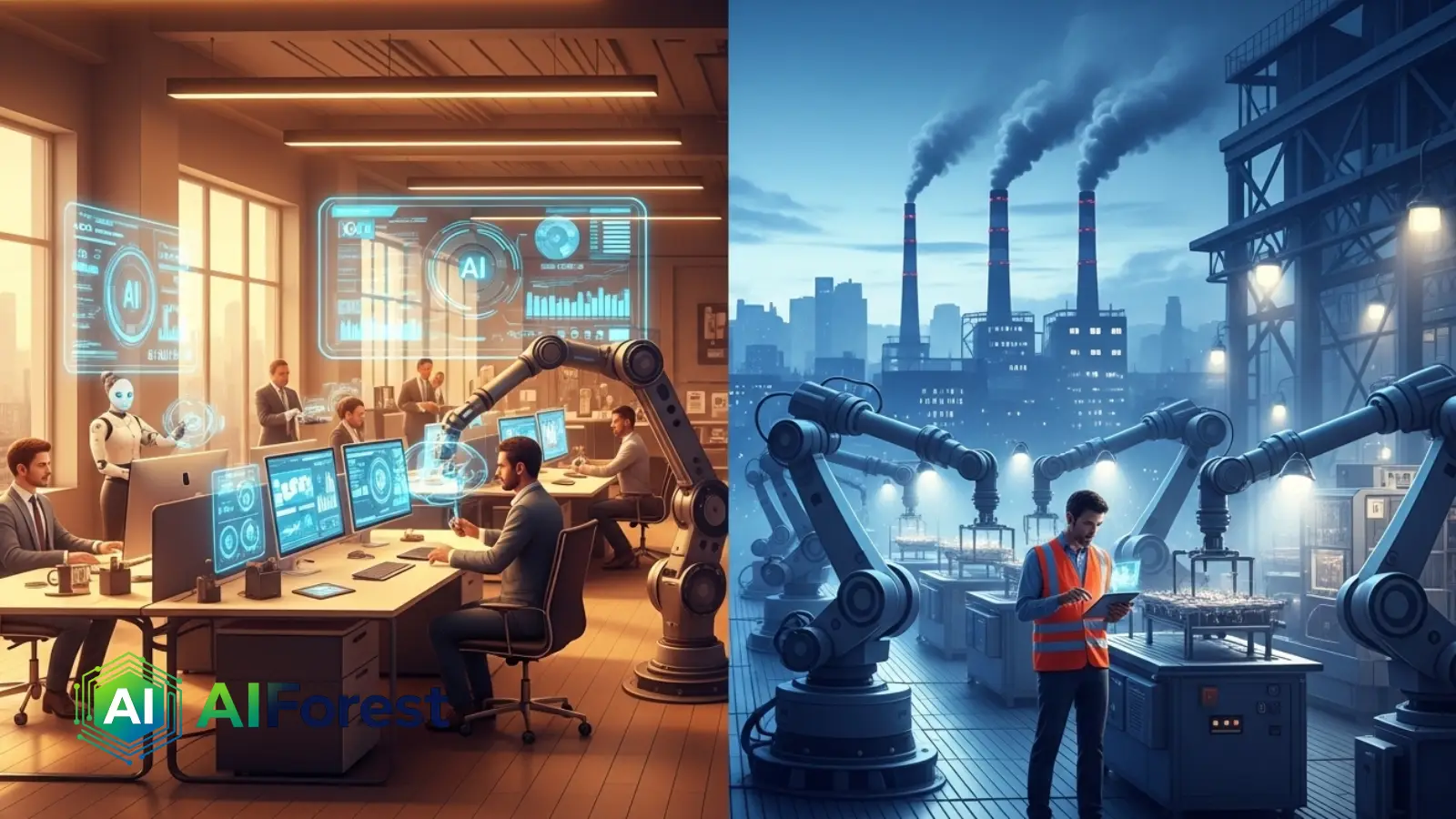
In January 2026, Goldman Sachs updated its labor displacement estimate: roughly 300 million full-time jobs could be exposed to automation driven by generative AI — with the United States and Western Europe accounting for the highest share due to their large knowledge-economy workforces. This isn’t a distant warning. It is already in motion.
The difference between 2024 and now is specificity. We are no longer talking about AI “affecting jobs broadly.” We are talking about paralegals in Chicago losing billable hours to contract-review AI, customer service teams in London being reduced by 40%, and junior data analysts in Frankfurt being replaced by AI-generated dashboards that update in real time. The shift is sector-by-sector, role-by-role.
The State of AI and Employment in 2026
What the Numbers Actually Say
The US Bureau of Labor Statistics reported in late 2025 that productivity in knowledge-sector firms rose 18% year-over-year, while hiring in those same sectors grew by only 3%. The gap — sometimes called the “productivity-employment scissors” — is AI doing more work with fewer people.
In Europe, the picture is regionally fragmented. Germany’s manufacturing sector has integrated AI-assisted robotics faster than any other EU nation. France and the Netherlands are seeing the steepest AI adoption in financial services. Meanwhile, Southern European economies, with higher rates of informal labor, are experiencing slower but accelerating disruption.
The common thread: mid-level, process-driven roles are disappearing fastest on both continents.
Which Sectors Are Being Restructured Most Aggressively?
The disruption is not random. It follows a clear pattern based on task repetitiveness and data availability:
- Legal services: AI tools now handle first-draft contract review, due diligence, and regulatory filings.
- Financial services: Algorithmic reporting, fraud detection, and client portfolio management are increasingly AI-first.
- Healthcare administration: Medical coding, insurance pre-authorization, and patient triage routing are being automated at scale.
- Software development: Junior and mid-level coding roles are being consolidated as AI code assistants handle 40–60% of output at major US tech firms.
- Customer support: Both the US and UK have seen large-scale contact center reductions, with AI handling tier-1 and tier-2 queries autonomously.
Key AI Tools Driving Workplace Transformation
Different sectors are adopting different solutions. Below is a comparison of three leading enterprise AI platforms currently reshaping white-collar work.
| Tool | Primary Use Case | Key Markets | Impact on Headcount |
|---|---|---|---|
| Microsoft Copilot 365 | Productivity, document generation, data analysis across Office suite | US, UK, Germany, Canada | Reduces time on admin tasks by est. 30–40%; affects EA and analyst roles |
| Harvey AI | Legal research, contract drafting, regulatory analysis | US, UK, EU law firms | Directly displacing paralegal and junior associate hours |
| Salesforce Agentforce | Autonomous customer service and sales pipeline management | US, UK, Australia | Reducing SDR and customer support team sizes by 20–45% in pilot firms |
These are not experimental tools. They are deployed at enterprise scale inside Fortune 500 companies and FTSE 100 firms right now.
The US vs. Europe: Two Different Approaches to the Same Problem
The American Model: Move Fast, Retrofit Later
The United States has no comprehensive federal AI labor policy in 2026. What exists is a patchwork of executive guidance, voluntary corporate commitments, and state-level attempts — most notably in California and New York — to regulate algorithmic management and automated hiring tools.
American corporations are largely free to integrate AI at the pace market competition demands. The result is faster productivity gains but also faster and less managed displacement. Workers in the US face AI-driven restructuring with limited institutional buffer — unemployment benefits, retraining programs, and union protections are inconsistent and often inadequate for the speed of change.
The European Model: Regulate First, Scale Second
The EU AI Act, which came into full enforcement in 2025, has created a different operating environment. High-risk AI applications — including those used in hiring, performance monitoring, and workplace surveillance — face strict transparency and accountability requirements.
This has slowed deployment in some sectors. But it has also produced greater worker visibility into how AI is being used to evaluate or manage them. EU member states, particularly Germany and Denmark, have incorporated AI transition planning into national labor agreements, requiring companies above certain sizes to consult with worker representatives before implementing AI that affects roles.
The trade-off is clear: Europe moves slower but with more structural protection. The US moves faster but with greater individual exposure.
Which Jobs Are Actually Growing?
The narrative of pure displacement misses something important. AI is also creating demand — but in different roles than those being eliminated.
Jobs showing strong growth in both the US and Europe include:
- AI trainers and prompt engineers — roles focused on managing and refining AI model behavior in enterprise contexts.
- AI ethics and compliance officers — particularly in regulated industries like healthcare, finance, and law in the EU.
- Data infrastructure specialists — the engineers building and maintaining the pipelines that AI systems depend on.
- Human oversight roles — in sectors like medicine, law, and high-stakes finance, regulators and courts are insisting on human sign-off on AI recommendations, creating new supervision roles.
- Skilled trades — electricians, plumbers, HVAC engineers, and construction managers remain largely automation-resistant due to the physical, unstructured nature of their work.

The pattern is this: AI is hollowing out the middle of the skills spectrum. The roles at the top (strategy, complex judgment, creativity at scale) and at the very bottom (physical, dexterous, relationship-driven work) are holding. The bulge in the middle is deflating.
The Human Root: What This Means for Workers, Ethics, and Creativity
The Displacement Is Not Neutral
Every conversation about AI and productivity should be grounded in a basic fact: the productivity gains accrue to capital owners first, not workers. When a law firm reduces its paralegal headcount by 30% and maintains revenue, that margin goes to partners — not to the paralegal finding a new job.
This is not a technological inevitability. It is a policy and power choice. The question is not whether AI creates enough new jobs to replace old ones in aggregate (it may). The question is whether the same workers who are displaced transition into those new roles — or whether the gains accumulate at the top while displaced workers fall through an inadequate safety net.
The Creativity Question
There is a separate, harder conversation about knowledge work identity. A paralegal who has spent a decade developing legal instinct is not simply going to retrain as an AI trainer. A financial analyst who finds that their core output is now generated in seconds by a model faces a crisis that is professional and existential.
The mental health dimension of AI-driven displacement is consistently underreported. Preliminary data from UK workforce surveys in 2025 suggests that workers in AI-exposed roles are reporting significantly higher rates of job insecurity anxiety — even among those who have not yet been displaced.
Creativity and judgment — the things that make professional work meaningful — are also the last places AI is truly competitive. This is where humans should be doubling down, not retreating.
The Verdict
The story of AI and jobs in 2026 is not a simple one of destruction or creation. It is a story of structural reorganization happening faster than institutions can adapt.
The US and Europe are running parallel experiments: one bets on speed and market correction; the other bets on regulation and managed transition. Neither has the full answer yet.
What is clear is this: workers who treat AI as a threat to passively absorb will lose ground. Those who treat it as a set of tools to actively direct — and who develop the judgment, communication, and strategic thinking that AI cannot replicate — will remain not just employable, but indispensable.
The forest is changing. The roots that go deepest will survive it.
FAQs
Roles that involve high-volume, process-driven tasks with structured data are most exposed. This includes paralegals, junior financial analysts, data entry specialists, customer service agents, and certain coding roles. Both the US Bureau of Labor Statistics and EU research bodies have flagged these categories as facing significant restructuring through 2028.
In aggregate, most major forecasts — including from the WEF, McKinsey Global Institute, and OECD — suggest that AI will create more jobs than it eliminates globally. However, the type, location, and skill level of those new jobs may not match those being displaced. The transition cost for individual workers could be severe even if the net numbers look positive.
The EU AI Act classifies AI systems used in employment, work management, and access to self-employment as high-risk, requiring transparency, human oversight, and accountability mechanisms. This means European workers have the legal right to know if AI is being used to evaluate their performance or manage their roles. The US currently has no equivalent federal standard — protections vary by state and are largely voluntary at the corporate level.











1 thought on “AI Is Reshaping Work in the US and Europe — Here’s What’s Actually Happening to Jobs”