The Forest View (TL;DR)
- Between March and June 2025 alone, community opposition led to $98 billion in data center projects being blocked or delayed across the United States.
- 27 US states are currently advancing legislation requiring data center developers to cover energy infrastructure costs, with California, Ohio, and Utah already enacting laws.
- The US now has more than 4,000 data centers — nearly eight times the number of any other country — and thousands more are planned or under construction, fueling growing public health and utility concerns.
The Bill Has Arrived
A Virginia homeowner named John Steinbach opened his electricity bill in January 2026 to find a charge of $281 — nearly three times his typical monthly payment. He had lived in his Manassas, Virginia home for nearly 40 years and had never seen anything close to it. “They’re building them like it’s ‘Field of Dreams’ — build it and the electricity will come — but we don’t see how that’s going to happen,” he said.
His frustration is far from isolated. Across the US, the physical expansion of AI infrastructure has collided hard with the lives of ordinary people — and the political consequences are now impossible for Big Tech to ignore.
The Scale of the Problem
How Much Power Are We Actually Talking About?
The numbers are genuinely staggering. A January 2026 report by Bloom Energy predicts that US data centers’ total combined energy demand will nearly double between 2025 and 2028, jumping from 80 to 150 gigawatts — roughly equivalent to adding a country with the energy needs of Spain in just three years.
In Virginia alone, data centers accounted for almost 40 percent of the state’s total electricity consumption in 2024. That single state statistic captures the asymmetry at the heart of this conflict: the benefits of AI are global, but the costs are hyperlocal.
Areas with high concentrations of data centers have seen electricity prices jump 267 percent over the past five years, according to a Bloomberg analysis. That is not an abstract policy figure — it is landing directly in household budgets.
The Water Nobody Talks About
Energy gets the headlines, but water may be the more quietly devastating issue. A typical data center uses 300,000 gallons of water per day — equivalent to the daily needs of about 1,000 households. Larger facilities can consume an estimated 5 million gallons per day, equivalent to the needs of a town of up to 50,000 residents.
A study by the Houston Advanced Research Center found that data centers in Texas will use 49 billion gallons of water in 2025, potentially reaching 399 billion gallons by 2030 — enough to draw down Lake Mead, the largest reservoir in the US, by more than 16 feet in a single year.
A new report from the UN University found that AI-related water consumption could equal the basic annual domestic needs of 1.3 billion people by the end of the decade. The water does not return — most of it evaporates in the cooling process.
The Political Revolt: A Rare Bipartisan Front
27 States and Counting
Twenty-seven states are currently considering legislation targeting large-load energy customers like data centers. Comparable legislation has already been enacted in California, Ohio, and Utah, spanning the ideological spectrum. Most of this legislation requires data center developers to bear the costs of new energy infrastructure.
Maine is poised to become the first state to enact a full data center construction moratorium, pausing new projects until November 2027 to allow the legislature time to study community impacts. At least 12 other states have filed moratorium bills in 2026.
In Wisconsin, residents used a ballot measure to block a proposed AI facility. In Independence, Missouri, voters ousted councilmembers who had supported a local data center. In Indianapolis, Indiana, a city councilor who backed a data center had shots fired through his window.
The $24.7 Billion Flashpoint in Virginia
The proposed $24.7 billion PW Digital Gateway project in Prince William County, led by QTS Realty Trust and Compass Datacenters, has been delayed by lawsuits and community protests over noise, environmental damage, and power-grid strain. Forty-two activist groups are now operating in Virginia alone, including the Data Center Reform Coalition.
Opposition to data center development has become firmly bipartisan: Republican officials often raise concerns about tax incentives and energy grid strain, while Democrats focus on environmental impacts and resource consumption. This cross-party resistance marks a rare area of alignment in an otherwise fractured political landscape.
The Comparison: How States Are Responding
| State / Action | Policy Response | Status (2026) |
|---|---|---|
| Maine | Full construction moratorium until Nov 2027 | Pending governor signature |
| California, Ohio, Utah | Laws requiring developers to cover grid infrastructure costs | Enacted |
| 27 States (combined) | Bills targeting large-load energy reporting and cost-shifting | Active legislation |
| Federal Government | Voluntary Ratepayer Protection Pledge (no legal enforcement) | Signed March 2026 |
| Wisconsin (Port Washington) | Voter referendum requiring approval before tax incentives | Passed 2:1, under legal challenge |
The federal government has made rapid data center construction a national priority, but state and local governments are increasingly scrutinizing new projects regardless. The federal executive order only applies to data centers above 100 MW, while many state bills establish reporting requirements for facilities with energy loads as low as 10 MW.
The Legal Front: Lawsuits as a New Tactic
The courtroom has become a critical battleground. In Minnesota, a court granted the Minnesota Center for Environmental Advocacy’s request for a temporary restraining order blocking construction of a data center, a ruling that signals to communities nationwide that lawsuits may be a viable tactic for halting projects.
Microsoft acknowledged the shifting landscape in an October securities filing, listing its operational risks as including “community opposition, local moratoriums, and hyper-local dissent that may impede or delay infrastructure development.” That is a significant admission from one of the world’s largest data center investors.
Big Tech firms Microsoft, Google, Amazon, and Meta — collectively spending hundreds of billions of dollars on data centers globally — have largely declined to comment publicly on the effect of community pushback. Their silence speaks its own volume.
The Hidden Costs: Who Actually Pays
The economics of data center development have a structural flaw that is increasingly visible to the public.
While the tax revenues of a new data center benefit only the host community, the entire electric service area must pay for associated infrastructure — new power plants, transmission lines, and grid upgrades — through charges added to utility bills.
A 2024 Virginia legislative report found that the state’s typical residential electricity bill could rise by $14 to $37 per month by 2040 because of grid strain tied to data center growth — a 9% to 25% increase over current average bills, before factoring in inflation.
These higher costs are not distributed equally. Lower-income families spend a higher share of their budget on electricity, and when bills rise, the consequences can include reduced access to adequate heating and cooling, and difficult choices between paying for energy and paying for food or healthcare.
The “Human Root”: Who Bears the Burden?
The data center boom is not simply an environmental debate. It is a question of who bears the cost of feeding the AI economy.
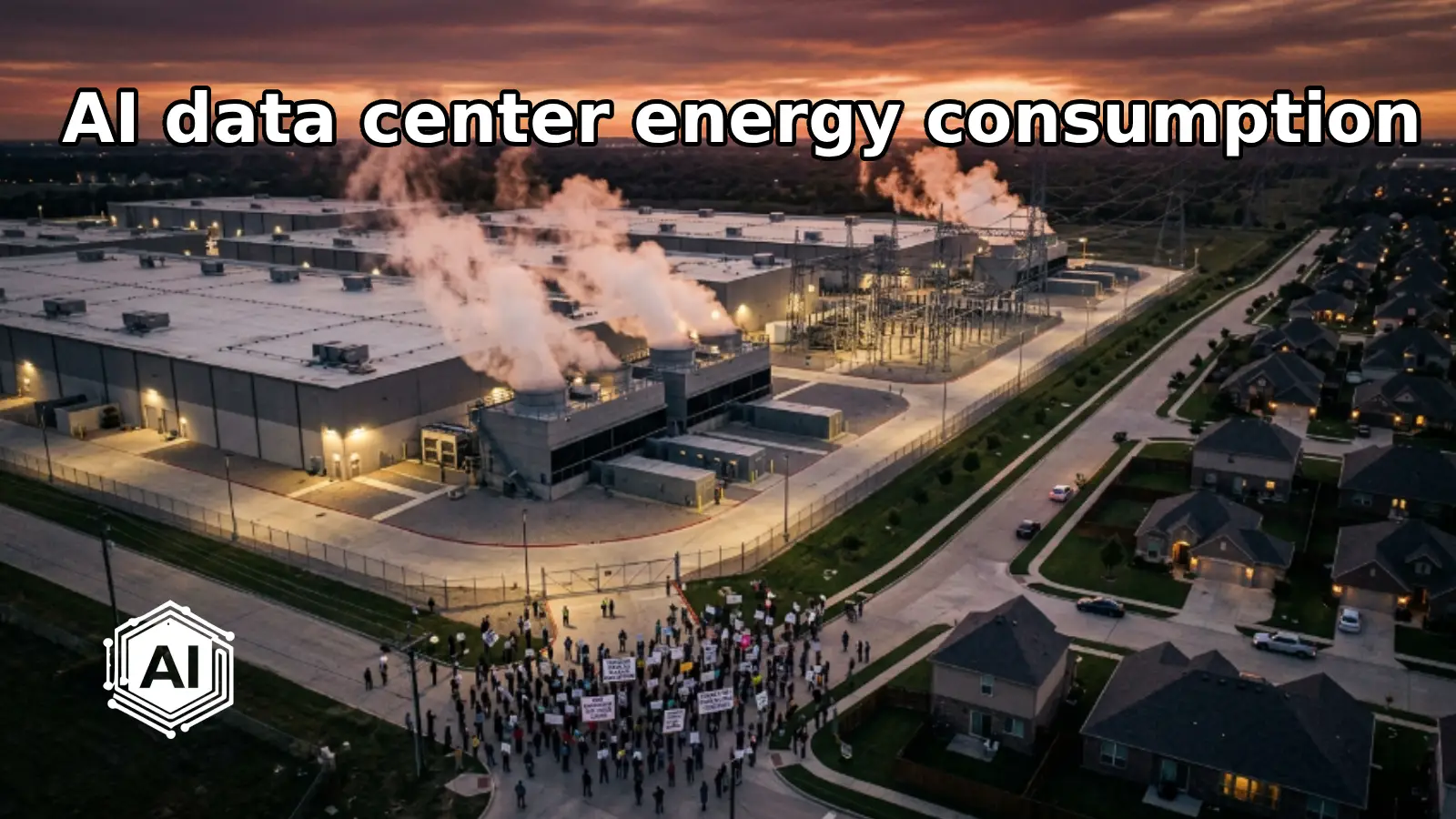
Once-sleepy municipal board meetings in farming towns and growing suburbs now feature crowded rooms of angry residents pressuring local officials to reject proposals. Residents report feeling betrayed when they discovered that officials had known about projects for an entire year before disclosing them publicly.
“It’s the secrecy. The secrecy just drives people crazy,” said one resident in a Minnesota community facing a data center project. That sentiment — the sense of being excluded from decisions that will reshape your neighborhood, your water supply, and your electricity bill — is the emotional engine behind the backlash.
Energy analyst Robert Bryce captured the mood bluntly: “I’ve never seen anything like the raging backlash against data centres. People are concerned about their neighborhoods, property values, viewsheds and noise.”
The jobs-and-taxes argument that local officials have used to sell these projects is also eroding under scrutiny. “People are starting to be really, really aware that these projects tend to be very extractive and bring very little to local communities,” one consumer advocate noted. Highly automated data centers employ relatively few people once construction ends.
The UN University’s June 2026 report frames the problem as one of environmental justice: the benefits of AI often flow across borders and sectors, while the environmental burdens of data center siting, electricity demand, and water withdrawals are concentrated in specific communities that frequently lack the political power to resist them.
The Verdict
The AI industry built its physical infrastructure on an assumption that communities would either not notice or not care. Both assumptions have proven wrong.
What is unfolding in 2026 is not a simple “anti-tech” protest movement. It is a structurally grounded political reckoning — driven by rising utility bills, declining water tables, and a widespread perception that the costs of AI are being socialized while the profits are privatized. The fact that resistance spans red and blue states, wealthy suburbs and rural farming towns, makes it uniquely difficult to dismiss or outmaneuver.
The industry’s voluntary Ratepayer Protection Pledge is a start, but it carries no legal force. States are filling that gap with enforceable law. Maine’s moratorium, if it survives legal challenge, could become a template that dozens of other states follow.
The next phase of the AI race will not be decided solely by chip performance or model architecture. It will increasingly be decided by zoning boards, state legislatures, and courtrooms — and by whether the industry can make a convincing case that it is a good neighbor.
Right now, in hundreds of American communities, the jury is still very much out.
FAQ
Data centers require enormous amounts of power, and when utilities invest in new infrastructure to meet that demand — new power plants, transmission lines, grid upgrades — those costs are spread across all ratepayers in a service area. While the tax revenues of a new data center benefit only the host community, the entire electric service area must absorb the infrastructure costs. The data center itself typically does not cover the full burden, so residential customers end up subsidizing the AI buildout through higher monthly bills.
A moratorium is a legal pause on new data center construction, giving legislatures time to study and regulate community impacts before approving further development. Maine is poised to become the first state to enact one, pausing new data center construction until November 2027. At least 12 other states have filed similar moratorium bills in 2026.
A typical data center uses around 300,000 gallons of water per day for cooling purposes — equivalent to the daily water needs of roughly 1,000 households. Larger facilities can consume up to 5 million gallons per day, comparable to an entire town of up to 50,000 people. Unlike water used in most industrial processes, much of it evaporates rather than being discharged and treated — meaning it is permanently removed from the local water supply.